
IMFW 2026 Filter Tuning Competition
This competition offers participants the opportunity to showcase either the effectiveness of their Computer-Aided Tuning program or the finesse of their manual tuning skills by tuning a complex bandpass filter in the shortest possible time. Each competitor will tune a 9th‑order filter on-site using the provided tuning tools and a vector network analyzer to meet the specified requirements.
Filter Description
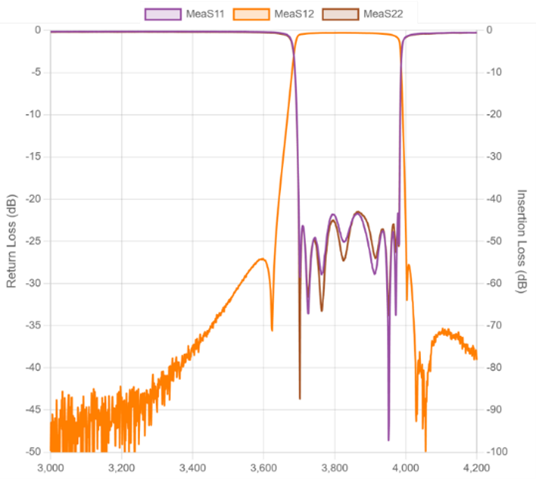
The 9th‑order filter is designed with 4 transmission zeros, realized through one cascade trisection and one quintet section. The coupling topology is illustrated in Fig. 1, while the synthesized coupling matrix is presented in Table I. A representative measured response of the filter is shown in Fig. 2.
Figure 1 The topology of the target filter.

Table I Synthesised coupling matrix
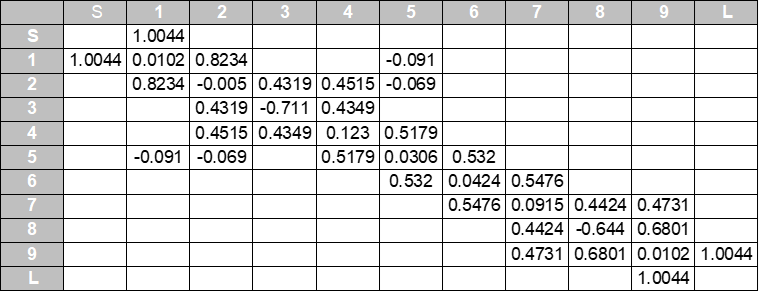
Figure 2 A typical measured response of the filter.
Filter Specifications
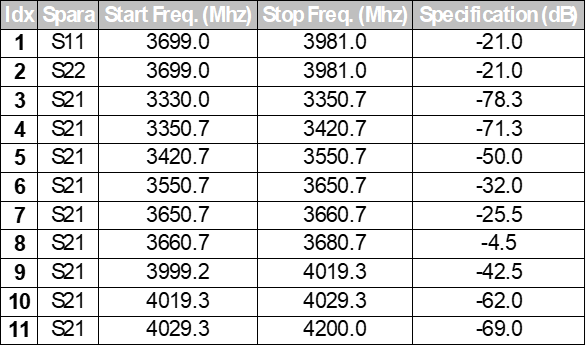
Center Frequency: 3,837 MHz | Bandwidth: 282 MHz
Reflection coefficient and rejection specifications:
Competition Procedure
- Each participant (or team) will tune the assigned filter on-site using all tools provided by the conference. A vector network analyzer (VNA) will be available; its model will be specified, and setup assistance will be provided by student helpers. The required specifications will be preloaded into the VNA.
- The initial condition of the filter is randomly set to ensure an unbiased starting point for each participant.
- Participants may choose either manual tuning or computer-aided tuning.
- For computer-aided tuning, participants must use their own laptop and proprietary software tools. The use of commercial software is not permitted.
- The total tuning time will be recorded from the initial state to the final state that meets all specifications. The maximum allowed tuning time is 30 minutes.
- The tuning setup will be available for software setup testing on February 6, and the competition will take place on February 7.
Assessment Criteria
- Final tuned response must meet or exceed the specified requirements.
- Total tuning time will be recorded and evaluated.
- The insertion loss at the band-edge frequencies will be considered.
Note: Both quality and tuning efficiency are essential — tune carefully, validate your results, and complete the tuning process as quickly as possible!
Data for Testing
To help participants to prepare computer-aided tuning tools, a set of measured S‑parameter (.s2p) data is provided.
Download Test Data: Access S-parameter Test Data
IMFW 2026 Filter Design Competition
Are you ready to put your filter design skills to the test? IMFW 2026 invites students to participate in an exciting competition focused on designing a bandpass filter for 5G wireless networks. Your challenge: walk us through the full design journey — from initial synthesis and coupling topology choices to physical implementation, EM simulation, and evaluating how your design could be mass-produced.
You can enter solo or as part of a team. Finalists will get the chance to present their work in a 30-minute session during the conference. Winners will receive official certificates and awesome prizes.
Design Specifications
- Physical format: flexible but a compact form factor with low insertion loss is highly recommended.
- I/O: coaxial connectors of 50 Ω with flexible locations.
- Frequency band: 3.5 GHz to 3.73 GHz
- Max reflection coefficient: -18 dB
- Max insertion loss (IL): < 1.6 dB, supposing that the conductivity of metal is 4.5×10⁷ S/m and loss tangent of dielectric (if used) is 5 × 10⁻⁵
- Max physical size: 15 (Height) × 1850 (Area) mm³ with maximum dimension less than 58 mm.
Rejection Specifications
| Frequency (MHz) | Specification (dB) | Frequency (MHz) | Specification (dB) |
|---|---|---|---|
| < 2437 | -58 | 2437~3338 | -70 |
| 3338~3479 | -40 | 3761~3881 | -40 |
| 3881~3952 | -45 | 3952~4044 | -40 |
| 4044~4609 | -25 | 4609~5137 | -56 |
| 5137~5883 | -25 | >5883 | -20 |
Assessment Criteria
- Presenting a clear, logic and rigorous design flow in 15 minutes
- Meeting most of the design specifications
- Readiness for mass production, including tunability
- Offering a relative low product figure of (inner volume × (maximum in-band IL dB)³)